Tuesday, 25 August 2015

Information Report - Our Amazing Solar System

Our Amazing Solar System
by:Curtis Tibbles
I am learning to write an information report

Have you ever wondered what is beyond our planet? Planet Earth is only one planet out of eight planets to orbit the sun in our very large Solar System.There are many things that orbit the Sun along with our planet, these include comets, asteroids, and moons.


The solar system is made up of the Sun and everything that orbits around it. The Sun is only a medium star and it is also a gas giant but it has no moons. The sun is the largest object in our Solar System containing 99.8 percent of the Solar System mass.

The planets names are Mercury, Venus, Earth, Mars, Jupiter, Saturn, Uranus and Neptune. Inner planets are made up of iron and rock, and the outer planets are giant worlds with thick layers of gas.

Pluto however is no longer considered a planet.This is because some planet’s moons are bigger than Pluto - even Earth is bigger! Hardly anything is known about Pluto but it is made up of a thin layer of nitrogen. Pictures taken by the Hubble Space Telescope show the layer of nitrogen that is Pluto. Pluto takes 248 years to orbit the sun, and it doesn’t go in a perfect circle. Pluto is also 7.5million kilometres away from the sun.

So now you know a bit about our solar system, the sun, planets, and Pluto. Next time at night look up at the stars try to see some planets, and prepare to be amazed.  


Information Report - Bald Eagle

Bald Eagle                       
 by Cameron Pereira
I am learning to inform my audience through an information report


Imagine you see a Bald eagle then you remember a bald eagle can only carry 5kgs then you also realize your baby brother is 5kgs and you see it come straight for you, so you take your baby brother inside. Hopefully he might take your pet fish instead!

Feature
A Bald Eagle is 1.8 or 2.3 metres tall. It has a hooked beak so food doesn’t fall out while it flies. A bald eagle isn’t bald, it is from Old English and it means white. A bald eagle reaches a speed of 160kmh (kilometres per hour.)

Where it’s Found
Bald eagles are found in Baja California, Florida and North to Alaska. Bald eagles nest in the tallest tree they can find. Also a bald eagle make the nest together              

Endangered
The Bald Eagle used to be endangered but now they are not because they are been taken care of by a lot of zoos in America and in the wild
In conclusion Bald eagles are the national bird of America which means they are a native, and very special to America. Bald eagles are carnivores which means they are meat eaters but don’t freak out because they can only lift prey if it’s 5 kgs or less. So next time you see a Bald eagle don’t kill it or   injured, because you don’t want to get this very special bird endangered.

Monday, 24 August 2015

Information Report - Blobfish

Blobfish   
By Rebecca Clement

I am learning to inform my audience through an information report

What is the ugliest fish on the planet? That's right, the Blobfish. Blobfish are naturally found in Australia, Tasmania and our very own New Zealand. The blobfish is known to live in very deep water. Did you know, that there are only around 450 blobfish left in the world? The blobfish was discovered relatively recently in 2003 and does not even look like a blobfish at all when it is in the water.
The Appearance.
The blobfish looks less ‘blobby’ in the water because the water allows it to float and spread out.  Did you know that what may look like a nose on the blobfish's face is actually lumps of skin. The fish is mostly made out of a jelly substance and does not have any bones, muscles and no swim bladder like normal fish.  Blobfish do not have swim bladders because they live in such
deep water that if they had a swim bladder then it would explode because of the water pressure.This means that they have no jaw.


The Diet
The blobfish's diet mainly consists of crabs, sea urchins, sea pens (which look just like a quill.) and anything that can fit in their mouth. Since the blobfish has no jaw it has no teeth. This means that if anything that can't fit in its mouth it can't eat. Blobfish can survive on one small meal for about half a year.

Altogether with it’s huge looking nose and one meal a month diet the blobfish is truly an amazing creature. So next you pull up a fishing net and there’s a big blob sitting at the bottom of the net look a little closer, you might think you are looking at an insignificant little pile sea slime, when really you could be looking at the one and only blobfish!!!

Information Report - Armadillo

Armadillo
By Xavier Setefano

I am learning to inform my audience through an information report.

Have you ever wondered what little creatures with shells on their back are. Well here are the answers to your questions about Armadillos. You may think armadillos will hurt You , well you’re wrong, Armadillos are harmless. Armadillos can be found in South America. There are over 20 species of armadillos.

Endangered
Armadillos are endangered and threatened by farm burning, hunting and domestic dogs. Armadillos are mammals and they build their own armor to protect them from any harm. Armadillos are the only mammals to have a rock hard shell on their back.
                                   Appearance
Armadillos have hard shells on their back have you ever  wondered what they were made of well their hard shells are made of really strong bone that's why Armadillos aren't that flexible. the name Armadillo comes from the spanish it means (little armored one) Armadillos night hunters that  Their colour is brown but giant Armadillos http://cdn-1.itsnature.org/Ground/images/article-pics/Armadillo.jpg
colours are black red grey and yellowish colouring.means they are both nocturnal.

Diet
Armadillos are fussy with their food they don't eat too hot to hard only soft and chewy. Armadillos love insects but not hard ones they love flies. The Armadillo has a keen sense of smell that is used to locate prey. Most of its diet is made up of insects grubs and worms. It will sometimes eat fruit, small reptiles,amphibians

In conclusion we should help these little endangered Armadillos  tell any hunters to please stop. This year  i want you to stop killing these poor animals and just leave them alone if you see one.

Friday, 21 August 2015

Information Report - The Deadly Brazilian Wandering Spider

The Deadly Brazilian Wandering Spider
    By David Botelho
I am learning to inform my audience through an information report.
            
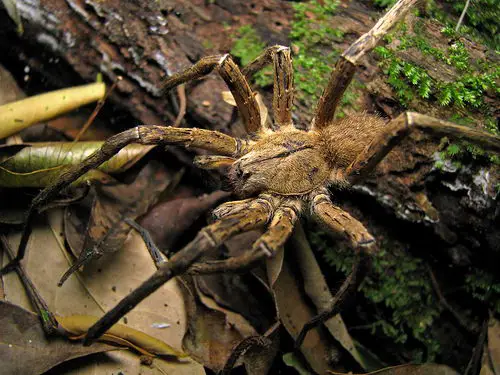
What is brown, has 8 legs and up to 8 eyes?That's right, a Brazilian Wandering Spider.  Did you know that a brazilian wandering spiders real name is Phoneutria and that means murderer in Greek. If you’re thinking you can fight it off with a broom, as we do with most of our eight-legged opponents, think again! The Brazilian wandering spider has been known to frequently climb up the broom handle and bite the human who’s trying to fight him off.
                                                                                                                                                                                                                                                                                                                                                                                                                                                                                                                                                                                                                                                                                                                                                                                    
Appearance/habitat:
The Brazilian Wandering Spider are mainly found in tropical South America, with one specie in Central America. These spiders are members of the Ctenidae family of wandering spiders.The Brazilian Wandering Spider is known for wandering the jungle floors during the night, rather than building a web or a lair hence the name. Since this spider is nocturnal, it usually searches for a dark place to take cover during the day which causes it to take cover in houses.

Diet:
Adult Brazilian Wandering Spiders feed on crickets, small lizards and mice. Even though they are fairly large they stick to their prey that is quite small. The struggle to be able to inject enough venom in larger prey to make them able to successfully kill it.If the prey was larger, it would take a large amount of venom to kill it which would create a struggle for the spider.

Venomous Bite:

Many people trap and kill them because they don’t want to take a risk. Breathing problems can occur as well due to the inflammation of the throat and the lungs. Once this venom mixes with serotonin there is going to be pain that is very severe in nature.
However, it should be emphasised here, that this behaviour is primarily defensive, although often mistaken for aggression. In rational terms, Phoneutria spiders only do the same as many other animals: They try to defend themselves when being threatened.The nocturnal spider that seconds before was sitting in a banana stalk, hiding from the daylight, now finds itself in a stressful situation, threatened to be crushed/killed by the five-fingered predator that is now having the spider in its grip. The natural response of the spider to such a situation is a bite.There is no doubt that the venom of some of the species is quite potent for mammals, including humans. Since there is not much information available about the evolution of these spiders, e.g. what triggered their defensiveness or their venom composition, we have to keep in mind that it may be a result of co-evolution of prey-predator interactions.
Mating:
In almost all spider species, the female is larger than the male. The female can be picky, and she often turns down many males before choosing the one she will mate with. Once she does pick one, the male needs to watch out; females often attack the males once copulation is finished.

So now you know that the Brazilian Wandering Spider is the world's deadliest and most venomous spider in the whole world.And did you know there is over thirty five thousand species of spiders and one of those species can kill up to five people and that specie is the Brazilian Wandering Spider the deadliest spider in the world.

Thursday, 20 August 2015

Information Report - The Blue Ringed Octopus

The Blue Ringed Octopus
By Bianca Arcilla
I am learning to inform my audience through an information report


Imagine yourself snorkeling in clear blue ocean in the Philippines on a public holiday. Suddenly you look at the reefs there and pick up a tiny octopus that could fit in the palm of your hand. Soon, the creature bites you and your dreamy holiday turns into a horrifying nightmare, because you have been bitten by the Blue-Ringed Octopus, one of the https://blogger.googleusercontent.com/img/b/R29vZ2xl/AVvXsEid_ikonlf9Z1HsUwgODkWomn12L5GFmxrTQLn9v5EjStBOZatmqjqLBqMY2Y5mUW41VSe0jPpgNSMzrwcUgerKoCVwrDdBq9Aivd7uAjfNypU9Klc80vqn8JaCrLwIiW34C7PcmYSys_k/s1600/blue-ringed_octopus.jpg
world’s most dangerous marine animals.  Blue-Ringed Octopuses are small octopuses that live under rocks on reefs in oceans near pacific islands such as Papua New Guinea, Australia, New Zealand, and Philippines. They also are easily identified by their blackish, yellowish skin and the blue rings all over their body. But beware, if these rings turn bright blue, you will get bitten.

Consequences of being bitten by a Blue-Ringed Octopus
  Blue-Ringed Octopuses are one of the world’s deadliest marine animals because of the effects that would happen if you got bitten by one. If you were bitten by these, you would find that your mouth and tongue would be numb, your vision would be blurry, you would have difficulty in speaking and in swallowing. These effects happen because whenever you get bitten by the Blue-Ringed Octopus, you receive some toxins called Tetrodotoxin and Histamine. These toxins are produced by the bacteria in the glands of the octopus and the octopus releases it’s venom on it’s prey too.

Diet
Blue-Ringed Octopuses have a diet of small crabs, shrimp and maybe even fish. These octopuses get their prey by pouncing on them and then pulling them towards their mouth. But female octopuses can’t eat while they are reproducing.

Reproducing\Life Cycle
Just like humans and other animals, Blue-Ringed Octopuses need to reproduce more Blue-Ringed Octopuses so that their species won’t become extinct. When Blue-Ringed Octopuses reproduce, first the male caresses the female’s mantle with his modified tentacle and next, the male places the tentacle in the female’s mantle cavity and then puts in the sperm packet. Then the spermatophores are released but soon, the male dies. Then the female lays 50-100 eggs and guards the eggs under her “skirt”. Last of all, the eggs then hatch and female Blue-Ringed Octopus dies. Also, when Blue-Ringed Octopuses are babies, they are the size of a pea, when they are an adult, they are the size of a golf ball. Later on, the life cycle of the Blue-Ringed Octopus will start again…… After the babies grow up : )

In conclusion, Blue-Ringed Octopuses are one of the world’s most dangerous marine animals because of the serious effect of being bitten by one. So you need to take care when you are snorkeling and stay away from them. And do remember, whenever their rings turn bright blue, they are ready.. to bite YOU!


Wednesday, 19 August 2015

Information Report - Wild Horses

Wild Horses

By Alice Barry

I am learning to inform with an information report

Imagine you are walking, just walking and ZOOM!!!! You can see a huge four legged creature leading what looked like 50 other animals. You’re wondering what these amazing creatures are, when it hit you. That was a wild horse! And of course! That horse that happened to come so close to you, was a stallion leading a pack of wild horses! Now you may be thinking that nobody would see such an amazing sight, but you are wrong. If you are walking on the west of America, and there are many fields of grass, and streams full of water, than that could possibly happen to you.
Diet                                  
Any type of horse (which includes wild horses) are herbivores, which means that they only eat plants and grass and drink from rivers, streams or lakes. They also have a fondness for hay, which is dried up grass. One of the natural habits that horses have are that they can walk and eat at the same time! It is estimated that these horses graze up to 15 to 17 hours a day. They survive on big fields of grass, and live on shrubs, plants and grass.

Protection
Are wild horses predators or prey?  Well, the answer to this is easy.  Seeing as horses are herbivores, this means that any kind of meat of any sort is not on the wild horses menu. A few of a wild horses predators are humans, mountain lions, wolves,coyotes and even bears. When a wild horse happens to come across one of its predators, it’s first idea to protect itself, will be to run away as fast as it can. Its second idea would be to kick. These two ideas would be the main ways that these horses make their protection  


Appearance
Wild horses appearance include four legs, a tail, a main, a skull/head, and a coat. This is what pretty much all wild horses would look like. Also just like our thumb print, all wild horses coat is different. Also, a fully grown wild horse can weigh about 700-800 pounds, and are usually 14 hands tall!

In conclusion these amazing four legged creatures, that are found west of America and that are herbivores are definitely an amazing part of our country and anyone walking in west of America would certainly be lucky to see one!